
Agile Leadership for Healthcare: A Research-Based Approach to Leadership Assessment and Organizational Transformation
Oct 25, 2026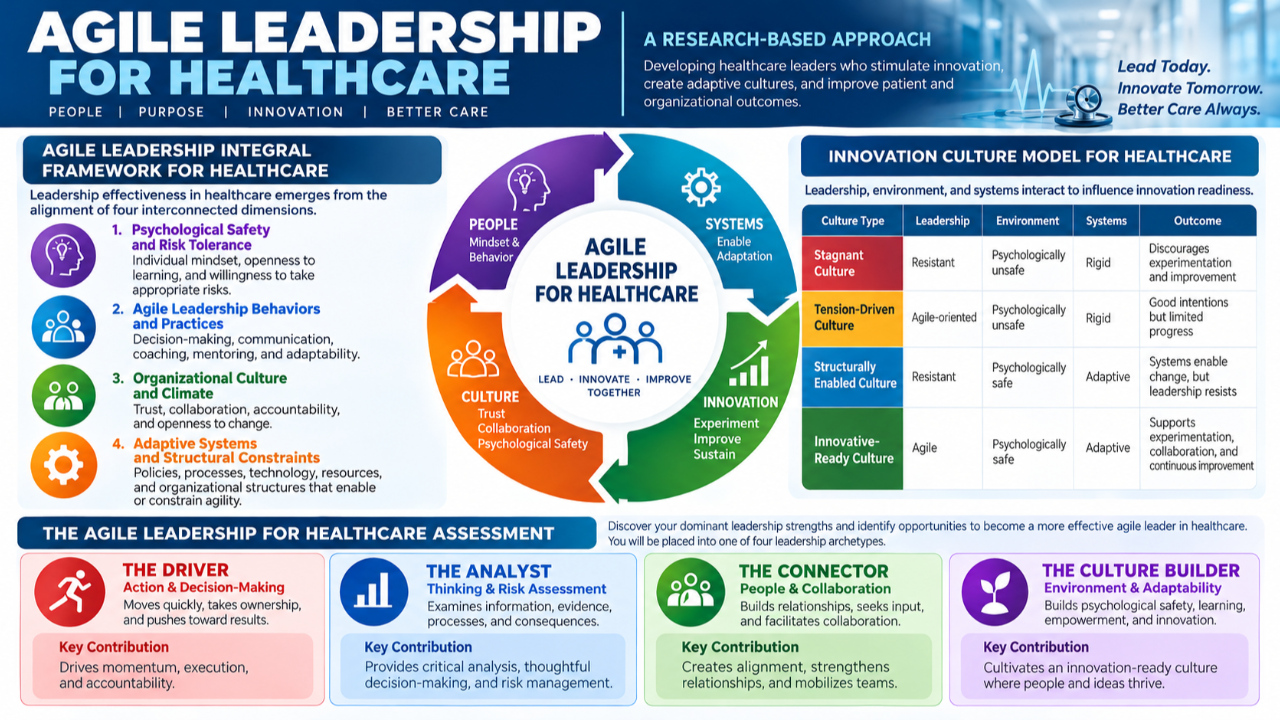
By Dr. Mario D. Wallace
All Things Strategic | Agile Leadership for Healthcare
The Evolution of Leadership Theories
For more than a century, leadership theories have shaped how organizations operate, compete, innovate, and manage human capital. From Fortune 500 corporations and healthcare systems to higher education institutions, manufacturing organizations, and small businesses, leadership theories have provided the foundation for developing leaders and improving organizational performance.
Many of these theories emerged in response to the changing social, political, technological, and economic conditions of their time. Behavioral leadership research, for example, gained prominence during the industrial expansion surrounding World War II, when organizations increasingly sought to understand how leadership behaviors influenced productivity, employee performance, and organizational effectiveness.
Similarly, situational leadership emphasized the importance of adapting leadership approaches to the developmental needs and readiness of employees.
Today, organizations draw upon numerous leadership theories and approaches, including transformational leadership, emotional intelligence, psychological safety, servant leadership, team leadership, adaptive leadership, and change leadership.
However, an important question remains: Were these leadership theories originally developed to address the unique complexities of healthcare?
In many cases, the answer is no.
The Problem with Traditional Leadership Theories in Healthcare
Leadership theories generally begin with a research question, a defined research methodology, and a sample population. Researchers investigate leadership phenomena, identify patterns, and develop theoretical explanations that may eventually influence leadership practices across industries.
Consider transformational leadership.
James MacGregor Burns introduced transformational leadership in his seminal 1978 work, Leadership. Burns was a political scientist whose research examined leadership through historical and political relationships, including the interactions between leaders and followers.
Although transformational leadership subsequently became widely adopted in business, education, and healthcare, its foundational work was not specifically designed to address healthcare delivery systems, clinical environments, patient safety, or the organizational complexities of modern medicine.
This does not diminish the value of transformational leadership or other established theories. Rather, it highlights an important distinction between leadership theories developed within a particular context and leadership theories subsequently adapted to other industries.
Healthcare organizations operate within complex environments characterized by clinical uncertainty, regulatory requirements, interdisciplinary teams, technological change, workforce shortages, patient safety considerations, and continuous pressure to improve outcomes while controlling costs.
These conditions raise a fundamental research question:
What would a leadership approach look like if it were developed specifically from the experiences, challenges, and organizational realities of healthcare leaders?
This question helped establish the foundation for Agile Leadership for Healthcare.
The Development of Agile Leadership for Healthcare
Drs. Mario D. Wallace, Malaz Boustani, and Edmond Ramly conducted a grounded theory research study examining leadership barriers to experimentation, innovation, and continuous improvement in healthcare organizations.
The research incorporated qualitative interviews and quantitative survey data, drawing from approximately 50 graduates of the Agile Implementation and Innovation Institute associated with Indiana University Health.
The research sought to understand how leadership behaviors, organizational cultures, and structural conditions influence the ability of healthcare professionals to implement innovation and continuous improvement.
Two guiding research interview questions included:
-
What role does leadership resistance play in hindering experimentation, innovation, and continuous improvement in complex healthcare environments?
-
What are the perceived challenges you have faced when gaining demand from leaders in healthcare settings regarding experimentation, innovation, and continuous improvement?
Through the analysis of participant experiences and perceptions, the research identified patterns involving leadership resistance, psychological safety, organizational culture, decision-making, and structural constraints.
The study informed the development of two conceptual frameworks:
-
Agile Leadership Integral Framework for Healthcare
-
Innovation Culture Model for Healthcare
Together, these frameworks provide an integrated approach to understanding leadership effectiveness and the organizational conditions necessary to stimulate innovation, adaptability, and continuous improvement.
The Agile Leadership Integral Framework for Healthcare
The Agile Leadership Integral Framework for Healthcare recognizes that leadership effectiveness cannot be explained solely through individual behaviors or personality characteristics.
Instead, agile leadership emerges through the interaction of individual mindsets, observable leadership practices, organizational culture, and structural systems.
The framework identifies four interconnected dimensions:
1. Psychological Safety and Risk Tolerance
Individual / Internal
This dimension examines how leaders think, respond to uncertainty, manage risk, and demonstrate openness to learning and feedback.
Leaders must develop the psychological capacity to challenge assumptions, tolerate appropriate risks, and create environments where experimentation is possible without compromising patient safety.
2. Agile Leadership Behaviors and Practices
Individual / External
This dimension focuses on observable leadership behaviors, including decision-making, coaching, communication, mentoring, engagement, and adaptability.
Agile leaders move beyond traditional command-and-control approaches by empowering employees and facilitating collaborative problem-solving.
3. Organizational Culture and Climate
Collective / Internal
Organizational culture influences whether employees feel safe expressing concerns, questioning existing practices, and recommending improvements.
Healthcare leaders must cultivate cultures characterized by trust, accountability, collaboration, learning, and openness to change.
4. Adaptive Systems and Structural Constraints
Collective / External
This dimension examines the organizational structures that either enable or inhibit agility.
Policies, procedures, workflows, staffing models, technology, regulatory requirements, and hierarchical decision-making structures can significantly influence innovation and organizational responsiveness.
The central premise of the framework is that sustainable healthcare innovation requires alignment between leadership mindsets, leadership behaviors, organizational culture, and operational systems.
The Innovation Culture Model for Healthcare
The second framework, the Innovation Culture Model for Healthcare, explains how leadership orientation, organizational environment, and adaptive systems interact to influence innovation readiness.
The model identifies four organizational culture types.
| Culture | Leadership | Environment | Systems |
|---|---|---|---|
| Stagnant Culture | Resistant | Psychologically unsafe | Rigid |
| Tension-Driven Culture | Agile-oriented | Psychologically unsafe | Rigid |
| Structurally Enabled Culture | Resistant | Psychologically safe | Adaptive |
| Innovative-Ready Culture | Agile | Psychologically safe | Adaptive |
Stagnant Culture: Leadership resistance, psychological insecurity, and rigid organizational systems discourage experimentation and continuous improvement.
Tension-Driven Culture: Leaders recognize the need for innovation, but organizational culture and structural barriers prevent their intentions from becoming sustainable practices.
Structurally Enabled Culture: Organizational systems and processes support adaptability, but leadership behaviors remain resistant to empowerment and innovation.
Innovative-Ready Culture: Leadership behaviors, psychological safety, organizational culture, and adaptive systems work together to support experimentation, collaboration, and continuous improvement.
The desired organizational condition is an Innovative-Ready Culture, where employees are empowered to contribute ideas, leaders support appropriate experimentation, and organizational systems enable rather than restrict innovation.
Introducing the Agile Leadership for Healthcare Assessment
Building upon these two frameworks, I developed the Agile Leadership for Healthcare Assessment, a leadership development instrument designed to help healthcare professionals understand their leadership strengths, identify developmental opportunities, and examine their capacity to support organizational innovation.
Unlike traditional leadership assessments that focus primarily on personality characteristics or general leadership preferences, this assessment is organized around leadership capabilities and organizational conditions associated with agility in healthcare.
The assessment examines five domains:
-
Psychological Safety and Risk Tolerance: How do I think, respond, and manage risk?
-
Agile Leadership Behaviors and Practices: How do I behave and lead others?
-
Empowerment, Learning, and Collaboration: How do I develop and mobilize people?
-
Organizational Culture and Climate: What environment are we creating?
-
Adaptive Systems and Structural Constraints: How does the organization enable or constrain agility?
These five domains help leaders identify both their strongest leadership capabilities and the areas requiring further development.
The assessment also introduces four leadership archetypes that translate assessment results into meaningful leadership development insights.
The Four Agile Leadership Archetypes
The assessment identifies four leadership archetypes: The Driver, The Analyst, The Connector, and The Culture Builder.
Each archetype represents a dominant leadership strength and a distinctive contribution to organizational performance.
| Archetype | Dominant Strength | Typical Leadership Behavior |
|---|---|---|
| The Driver | Action and decision-making | Moves quickly, takes ownership, and pushes toward results |
| The Analyst | Thinking and risk assessment | Examines information, evidence, processes, and consequences |
| The Connector | People and collaboration | Builds relationships, seeks input, and facilitates collaboration |
| The Culture Builder | Environment and adaptability | Builds psychological safety, learning, empowerment, and innovation |
The Driver: Turning Decisions into Action
Drivers emphasize execution, accountability, responsiveness, and results.
They are often comfortable making timely decisions and mobilizing teams toward organizational objectives.
Their developmental challenge may involve balancing decisive action with employee engagement, collaboration, and thoughtful reflection.
The Analyst: Understanding Risk and Evidence
Analysts emphasize critical thinking, evidence-based decision-making, reflection, and risk assessment.
They contribute to organizational effectiveness by examining problems, evaluating alternatives, and considering potential consequences.
Their developmental challenge may involve avoiding excessive analysis that delays experimentation or timely decision-making.
The Connector: Building Relationships and Collaboration
Connectors emphasize trust, communication, employee participation, and collaborative problem-solving.
They help strengthen relationships across departments and create conditions where employees feel comfortable sharing ideas and concerns.
Their developmental challenge may involve balancing collaboration with difficult conversations, decisive action, and accountability.
The Culture Builder: Creating Conditions for Innovation
Culture Builders emphasize organizational adaptability, psychological safety, systems thinking, and continuous improvement.
They focus on aligning leadership behaviors, workplace culture, processes, and organizational structures to support innovation.
Their developmental challenge may involve translating cultural aspirations into measurable organizational outcomes and sustained strategic execution.
Why the Four Archetypes Matter
The purpose of the assessment is not to permanently label healthcare leaders or suggest that one archetype is superior to another.
Instead, the archetypes provide a developmental framework for understanding how leaders contribute to organizational effectiveness.
A leader whose strongest domain aligns with the Driver archetype may benefit from developing the collaborative strengths of the Connector.
Similarly, an Analyst may benefit from learning how Drivers translate evidence into timely action, while a Connector may strengthen organizational effectiveness by adopting the systems-oriented perspective of the Culture Builder.
Agile leadership is not about becoming one particular type of leader. It is about developing the capacity to integrate the strengths of all four archetypes.
This integration becomes especially important in healthcare, where successful innovation requires clinical evidence, timely decisions, interdisciplinary collaboration, psychological safety, and adaptive organizational systems.
From Leadership Assessment to Organizational Transformation
The Agile Leadership for Healthcare Assessment is intended to serve as more than an individual leadership development exercise.
It provides a starting point for examining how leadership behaviors influence organizational culture and the implementation of innovation.
Assessment results can help leaders:
-
Identify their dominant leadership strengths and developmental gaps.
-
Understand how their behaviors influence employees and interdisciplinary teams.
-
Recognize cultural and structural barriers to experimentation and improvement.
-
Develop targeted leadership improvement strategies.
-
Align leadership behaviors with organizational strategy and innovation priorities.
-
Strengthen collaboration, accountability, and organizational adaptability.
The assessment can also support leadership workshops, executive coaching, team development, and organizational transformation initiatives.
By connecting individual leadership development with organizational culture and systems, healthcare organizations can begin moving from traditional hierarchical approaches toward more adaptive and innovation-ready environments.
The Future of Leadership in Healthcare
Healthcare is undergoing extraordinary transformation.
Artificial intelligence, digital health technologies, changing workforce expectations, rising operational costs, and increasingly complex patient needs require leaders who can think differently, respond quickly, and continuously improve organizational performance.
Traditional leadership theories will continue to provide valuable insights. However, healthcare organizations also need leadership approaches developed from research examining the specific complexities of healthcare environments.
The Agile Leadership Integral Framework for Healthcare, Innovation Culture Model for Healthcare, and Agile Leadership for Healthcare Assessment represent an effort to address this need.
The ultimate objective is not simply to develop better individual leaders.
It is to create healthcare organizations where leadership, people, culture, technology, and systems are aligned to support continuous learning, innovation, and improved organizational performance.
Take the Agile Leadership for Healthcare Assessment
Are you a Driver, Analyst, Connector, or Culture Builder?
Discover your dominant leadership strengths and identify opportunities to become a more effective agile leader in healthcare.
Take the Agile Leadership for Healthcare Assessment today.
Upon completing the assessment, you will receive your results by email for review, including insights into your leadership archetype and developmental opportunities.
Understanding your leadership strengths is the first step toward transforming how you lead, collaborate, and innovate.
Assessment:
https://docs.google.com/forms/d/e/1FAIpQLSc1Gnw0JgyqeA1xMhn48zrcXbYJVFUfwZbiCmi_kCBGEwTbzw/viewform
Dr. Mario D. Wallace
Leadership Researcher | Corporate Strategist | Educator
All Things Strategic
Email: info@allthingsstrategic.org