
Strategic Planning Maturity & Fitness Assessment: Building Leadership Competency for Strategic Success
Oct 26, 2026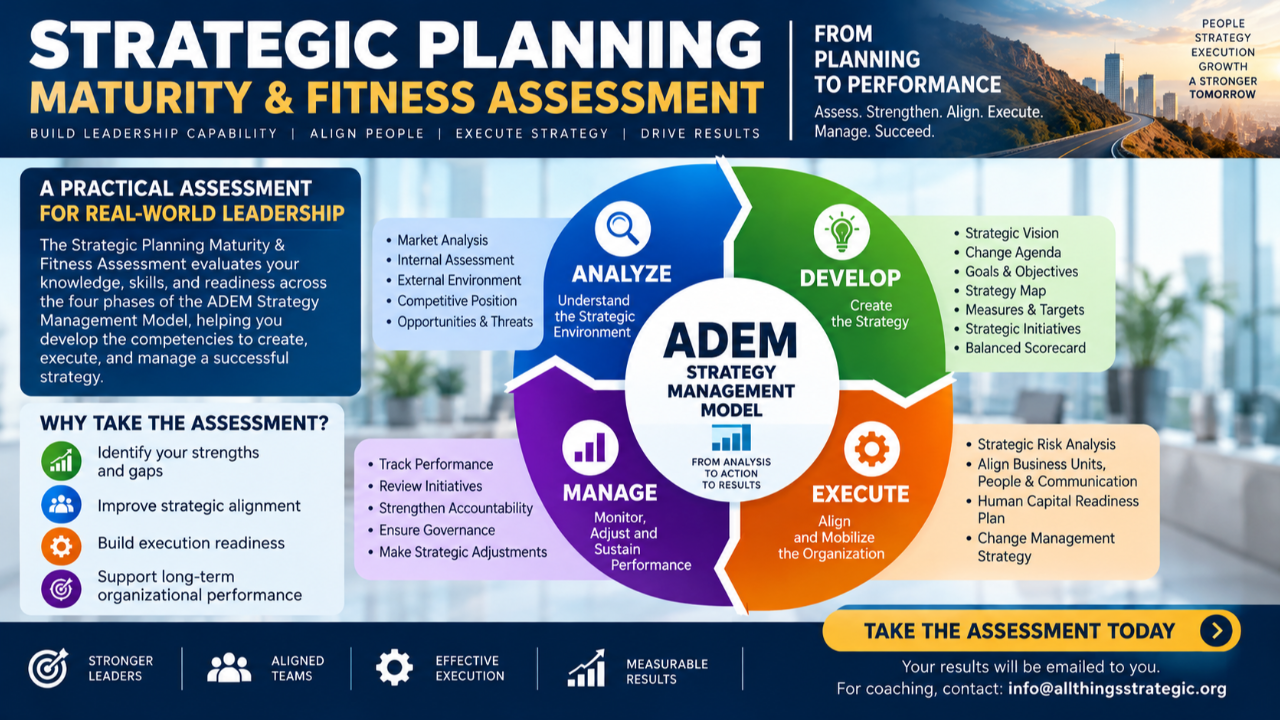
By Dr. Mario D. Wallace
Founder, All Things Strategic | Creator, ADEM Strategy Management Model
The Challenge of Strategic Planning in Modern Organizations
Strategic planning is one of the most important yet labor-intensive responsibilities facing executive leaders across industries. Whether leading a Fortune 500 corporation, healthcare system, university, manufacturing organization, government agency, or small business, executives are responsible for establishing a strategic direction that drives organizational growth, competitiveness, and long-term sustainability.
However, developing a strategic plan requires much more than establishing a vision and identifying organizational goals.
An effective strategy management process involves conducting a comprehensive market analysis, developing a strategic vision, establishing a change agenda, defining strategic goals and objectives, constructing a strategy map, establishing performance measures and targets, identifying strategic initiatives, and ultimately developing a Balanced Scorecard.
Each of these activities requires specialized knowledge, analytical competencies, strategic thinking, and an understanding of how the various components connect.
The challenge is that many executive leaders are expected to develop and execute organizational strategies without possessing the competencies necessary to navigate every stage of the strategy management process.
Even more concerning, leaders may understand individual strategic planning activities but lack the knowledge of how to sequence them appropriately to maintain alignment and integrity throughout the process.
As a result, organizations often develop strategic plans that look impressive on paper but struggle to translate those plans into measurable organizational performance.
Why Strategic Planning Competency Matters
Strategic planning is not simply an annual executive exercise. It is an integrated management discipline requiring leaders to understand the relationships among organizational analysis, strategic development, execution, and performance management.
For example, an organization may establish strategic objectives without conducting an adequate market analysis. Another may identify strategic initiatives without determining whether its workforce possesses the competencies necessary to execute them.
Some organizations invest significant resources in developing strategic plans but fail to establish governance structures, accountability mechanisms, or performance measures to monitor implementation.
These challenges highlight a fundamental issue:
An organization cannot consistently execute a strategy if its leaders lack the knowledge, skills, and competencies required to develop, align, execute, and manage that strategy.
This realization led me to develop the Strategic Planning Maturity & Fitness Assessment, a leadership development instrument centered on my ADEM Strategy Management Model.
Introducing the ADEM Strategy Management Model
The ADEM Strategy Management Model provides a structured approach to strategic planning and organizational performance management.
ADEM represents four interconnected phases:
Analyze → Develop → Execute → Manage
Each phase contains strategic drivers that guide leaders through the strategy management process. On average, each phase includes approximately four drivers designed to strengthen strategic decision-making, organizational alignment, and execution.
The model emphasizes that strategic planning activities should not occur independently. Instead, each phase should inform and strengthen the next, creating an integrated process from strategic analysis through performance management.
Phase 1: Analyze — Understanding the Strategic Environment
The Analyze phase establishes the foundation for strategic decision-making.
Before developing a strategy, leaders must understand their organization's internal capabilities, external environment, competitive position, emerging opportunities, and potential threats.
This phase encourages executives to evaluate the conditions influencing organizational performance and identify the strategic challenges that must be addressed.
Without a comprehensive understanding of the current environment, leaders risk developing strategies based on assumptions rather than evidence.
The central question is: Do we understand our organization and the environment in which it operates?
Phase 2: Develop — Translating Analysis into Strategy
The Develop phase focuses on establishing a clear strategic direction and translating organizational priorities into actionable strategic objectives.
This includes developing a strategic vision, establishing a change agenda, defining goals and objectives, creating a strategy map, identifying performance measures and targets, and determining strategic initiatives.
A critical component is understanding the relationship between strategic objectives and how they collectively contribute to organizational outcomes.
For example, improving workforce competencies may strengthen operational processes, enhance stakeholder experiences, and ultimately contribute to improved financial performance.
The Balanced Scorecard provides a framework for translating these strategic relationships into measurable performance expectations.
The central question is: Can we translate our strategic vision into a clear, aligned, and measurable strategy?
Phase 3: Execute — Aligning the Organization to Strategy
Developing a strategy is only the beginning. The real challenge is mobilizing the organization to execute it.
Within the ADEM model, the Execute phase includes several essential strategic drivers:
-
Conduct Strategic Risk Analysis: Identify risks that may prevent successful strategy implementation and develop appropriate mitigation approaches.
-
Align Business Units, People, and Communication to Strategy: Ensure departments, employees, and organizational communication reinforce strategic priorities.
-
Create a Human Capital Readiness Plan: Evaluate whether employees possess the competencies, skills, capabilities, and resources required to execute the strategy.
-
Develop a Change Management Strategy: Prepare leaders and employees for the behavioral, cultural, and operational changes necessary for successful implementation.
These drivers address a common organizational challenge: the disconnect between strategic planning and operational execution.
An organization may possess a well-developed strategic plan but fail because employees do not understand their responsibilities, departments operate in silos, or leadership does not adequately prepare the workforce for change.
The central question is: Is our organization strategically aligned and prepared to execute the plan?
Phase 4: Manage — Sustaining Strategic Performance
The Manage phase focuses on ensuring that strategic planning becomes a continuous organizational management process rather than an annual event.
Leaders must monitor performance, evaluate progress toward strategic objectives, review initiatives, strengthen accountability, and make necessary strategic adjustments.
A Balanced Scorecard can help executives evaluate whether organizational activities are producing the intended strategic outcomes.
Equally important is establishing a governance process that creates regular opportunities to review strategic performance and respond to changing organizational conditions.
The central question is: Do we have the leadership discipline and management processes necessary to sustain strategic performance?
Introducing the Strategic Planning Maturity & Fitness Assessment
Building upon the ADEM Strategy Management Model, I developed the Strategic Planning Maturity & Fitness Assessment to evaluate leaders' knowledge, competencies, and readiness across the strategic planning and management process.
The assessment examines the strategic drivers within each of the four ADEM phases, helping executives and middle managers identify their strengths and areas requiring further development.
The assessment focuses on two important dimensions:
Strategic Planning Maturity examines a leader's understanding and demonstrated competency in the activities required to analyze, develop, execute, and manage organizational strategy.
Strategic Planning Fitness focuses on a leader's readiness and capacity to apply those competencies to the practical demands of organizational strategic planning and execution.
Together, these dimensions provide leaders with a structured opportunity to reflect on their strategic management capabilities.
Rather than assuming that executive experience automatically translates into strategic planning expertise, the assessment encourages leaders to examine their competency across the entire strategy management process.
Why Executive Leaders and Middle Managers Should Take the Assessment
Strategic planning is often perceived as the responsibility of senior executives. However, successful execution depends heavily on middle managers who translate organizational strategy into departmental priorities, employee responsibilities, and daily operational activities.
Executive leaders establish strategic direction, but middle managers play a critical role in implementing change, aligning resources, managing performance, and reinforcing accountability.
The Strategic Planning Maturity & Fitness Assessment is designed to help both leadership groups strengthen their strategic management capabilities.
Through the assessment, participants can:
-
Identify strategic planning strengths: Recognize the ADEM phases and drivers where they demonstrate the greatest competency.
-
Discover competency gaps: Identify areas requiring additional knowledge, development, or coaching.
-
Improve strategic alignment: Better understand how business units, employees, culture, and communication connect to organizational strategy.
-
Strengthen execution readiness: Evaluate their ability to support strategic risk management, human capital readiness, and organizational change.
-
Develop performance management capabilities: Improve their understanding of how to monitor, evaluate, and manage strategic outcomes.
-
Create a personalized development pathway: Use assessment results to prioritize professional development and executive coaching.
The goal is not simply to assess strategic planning knowledge. It is to help leaders develop the competencies necessary to guide their organizations through a disciplined, integrated, and measurable strategy management process.
From Strategic Planning to Strategic Management
One of the greatest misconceptions about strategic planning is that the process ends when the strategic plan is completed.
In reality, developing the plan represents only one component of effective strategy management.
Organizations must continuously align their people, culture, processes, technology, and resources to their strategic priorities.
This requires leaders who understand not only how to develop a strategy but also how to operationalize it, monitor its effectiveness, and adapt when organizational conditions change.
A strategic plan does not create organizational performance by itself. Leaders must possess the competencies to translate that plan into coordinated action and measurable results.
The ADEM Strategy Management Model and Strategic Planning Maturity & Fitness Assessment were developed to help close this leadership competency gap.
Take the Strategic Planning Maturity & Fitness Assessment
How prepared are you to lead your organization through the entire strategic planning and management process?
Do you possess the competencies necessary to analyze your organizational environment, develop an integrated strategy, align your workforce, execute strategic initiatives, and manage performance?
Or are there strategic management capabilities that require additional development?
I invite executive leaders, middle managers, and emerging leaders to take the Strategic Planning Maturity & Fitness Assessment: https://docs.google.com/forms/d/e/1FAIpQLScCqw3vEWd8WYa6VPGyBIium5BjjIh7voEEADDifs-jJe9SlQ/viewform
Upon completing the assessment, you will receive your results by email for review, helping you identify your strategic planning strengths and opportunities for improvement.
If you would like additional guidance, you are also welcome to contact me to arrange an initial coaching session to discuss your results and explore strategies for strengthening your strategic planning capabilities.
Effective strategic planning begins with competent leaders. Sustainable strategic performance requires leaders who can analyze, develop, execute, and manage strategy.
Dr. Mario D. Wallace
Founder, All Things Strategic
Creator, ADEM Strategy Management Model
Corporate Strategist | Leadership Researcher | Executive Coach
Email: info@allthingsstrategic.org